
English follows
Christopher Nolan’ın The Odyssey filmi, Odysseus’un yıllar süren “eve dönüş” hikâyesini yeniden gündeme getirirken, bu anlatı Kıbrıslıların tarihsel hafızasında bambaşka bir karşılık buluyor. Şöyle ki Kıbrıs, tarih boyunca hem bir varış hem de bir ayrılış adası oldu; adalı olmanın kaderlerinden biri göçtü.
Odysseus’un İthaka’ya dönemeyişi, bugün çoğunlukla Birleşik Krallık, Avustralya, Kanada ve dünyanın başka yerlerinde yaşayan Kıbrıslıların “uzakta ama memleketle bağını koparmamış olma” hâlini hatırlatıyor. Üstelik Kıbrıs mitolojisi de bu “eve dönüş” temasına doğrudan bağlanıyor: Troya Savaşı’ndan sonra sürgüne çıkan Teukros, efsaneye göre, babası onu Salamis adasına almadığı için Kıbrıs’a gelerek kendi yurdu Salamis’in adını burada yeniden yaşattı. Böylece Kıbrıs, başka bir yurdu terk eden bir kahramanın yeni yurt kurduğu ada olarak da anlatıya girer.
Bu anlatıda Salamis bunun en güçlü sembollerinden biridir. Teukros’un efsanevi kuruluşundan Roma ve Bizans dönemlerine, depremlerden terk edilişine kadar kent, Kıbrıs’ın ticaret, savaş, göç ve medeniyetlerin kesişme noktası olma hikâyesini taşır.
Bugün garantör devletlerden Birleşik Krallık(İngiltere) Kıbrıs’ı yönettiği zamanlarda Salamis’ten alınıp British Müzesi’nde sergilendiği tarihi eserler de adadan uzakta Londra’da, adalının tarihini insanlara anlatıyor.
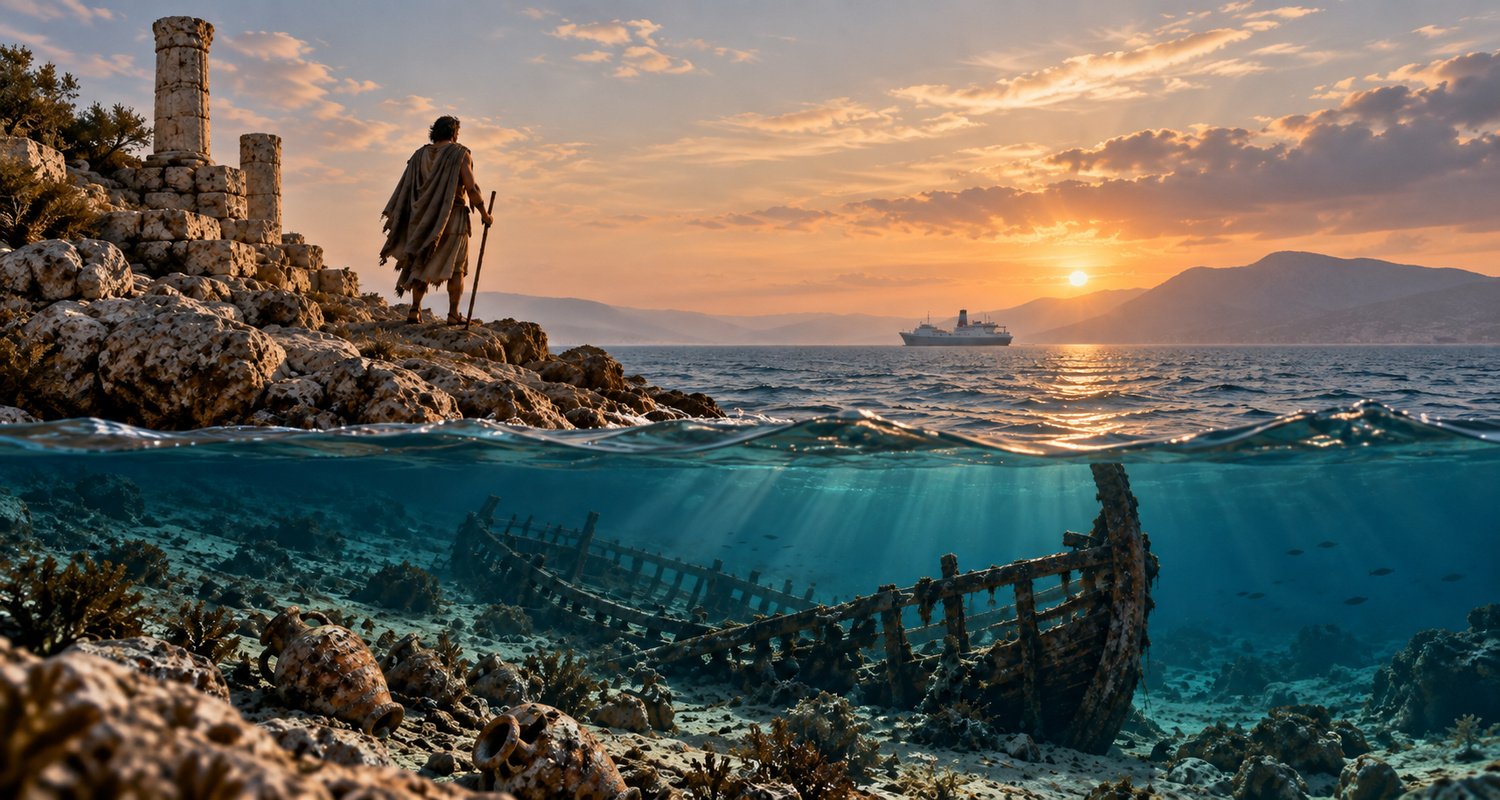
Salamis Antik Şehri (Salamis Ancient City) olarak bilinen MS 4. Yüzyılda (MS 332-342) meydana şiddetli depremler ve ardından oluşan tsunami dalgaları sonucunda kentin kıyı şeridi, eski liman tesisleri ve bazı dalgakıran yapıları denizin altında kalmasının yanında, Kıbrıs’ın Akdeniz’inde limanlar ve çevredeki batıklar da adanın tarihinin yalnızca karada değil, denizin hafızasında da saklı olduğunu bize gösterir.
Girne açıklarında bulunduğunda su altı arkeolojisi açısından bir dönüm noktası olma niteliği taşıyan Girne batığı, Doğu Akdeniz’de ahşap gövdesi günümüze kadar en iyi korunmuş antik ticaret gemilerinden biridir. MÖ 4. yüzyıla ait olan bu batık; Mazotos Batığı, Amathus limanı ve Kıbrıs açıklarında Levanten Denizi’nde, Kıbrıs ile Lübnan arasında keşfedilen diğer batıklarla birlikte, adanın binlerce yıllık denizcilik ve ticaret tarihinde yer alır. 1630 yılı civarında Mısır’dan İstanbul’a giderken battığı düşünülen büyük Osmanlı ticari gemisinin literatürde özel ve tescilli bir ismi bulunmadığından bilinen ismi ile ‘Osmanlı ticaret gemisi batığı’ Kıbrıs kıyılarındaki sayısız çapa, amfora ve liman kalıntısı aynı hikâyenin farklı parçalarıdır: Bilindiği üzere Kıbrıs hiçbir zaman Akdeniz’in dışında duran bir ada olmadı; tam tersine Akdeniz’in ortasında hareket eden insanların, malların, kültürlerin ve dillerin kesiştiği bir kavşak oldu.
Bugün Akdeniz’deki bu ada, sadece kıyılarındaki denizin altındaki tarihi batıklarıyla değil enerjinin ve jeopolitiğin merkezinde duruyor. Doğu Akdeniz’deki doğal gaz sahaları, Kıbrıs’ın denizlerdeki stratejik konumunu yeniden dünya gündemine taşıyor. Kıbrıs, Doğu Akdeniz’in en önemli hidrokarbon arama ve üretim sahalarından biri konumundadır. Adanın güney kıyılarında yapılan keşifler ve kuzeydoğu kesimlerindeki yetki tartışmaları hem bölgesel enerji dengelerini hem de jeopolitiği doğrudan etkilemektedir. Antik çağdan beri gemilerin uğradığı bu denizler bugün enerji yollarının, ekonomik çıkarların ve siyasi anlaşmazlıkların merkezinde.
Bütün bu hikâyeler aslında tek bir ortak temaya bağlanıyor: Kıbrıs ve hareket.
Odysseus yola çıkar ve yıllarca evine dönmeye çalışır.
Teukros yurdunu terk eder ve başka bir Salamis kurar.
Tüccarlar gemileriyle adaya uğrar, bazıları denizin dibinde kalır.
Bugünün Kıbrıslıları ise dünyanın dört bir yanına dağılır ama hafızalarında adayı taşırlar.
Belki de Kıbrıs’ın en büyük paradoksu budur: Bir ada, ama insanlarını sürekli yola çıkaran bir ada.
Ve Odysseus’un asıl hikâyesi de belki tam burada Kıbrıslılara dokunuyor:
İnsan bazen memleketinden uzaklaşır; fakat memleket, insanın içinden hiç uzaklaşmaz.
Kaynakça:
‘The Odyssey’, (2026 film).
‘Mitoloji Sözlüğü’, Azra Erhat. 2007, Remzi Kitabevi.
‘Odisseia’, Homeros. 1984, Can Yayınları.
One Island, a Thousand Returns: From Odysseus to the Cypriots
This essay is dedicated to those who lost their lives
when the passenger ship that departed from Kyrenia Port on 30 August 2026 sank.
As Christopher Nolan’s The Odyssey brings Odysseus’s years-long journey “home” back into the public imagination, the story resonates in a very different way within the historical memory of Cypriots. Cyprus has, throughout history, been both an island of arrival and an island of departure; migration has been one of the enduring destinies of island life.
Odysseus’s inability to return to Ithaca is reminiscent of the experience of Cypriots who today live in the United Kingdom, Australia, Canada and elsewhere in the world: being far away, yet never having severed their connection with home. Cyprus’s own mythology is also directly connected to this theme of “returning home.” According to legend, Teucer, having been exiled after the Trojan War, came to Cyprus after his father refused to allow him to return to Salamis. Here, he gave the name of his homeland, Salamis, to the city he founded. Thus, Cyprus enters the story as an island where a hero who had left one homeland created another.
In this narrative, Salamis is one of its most powerful symbols. From its legendary foundation by Teucer through the Roman and Byzantine periods, to the earthquakes and eventual abandonment of the city, Salamis carries within it the story of Cyprus as a crossroads of trade, war, migration and civilisations.
Today, some of the historical artefacts removed from Salamis and displayed at the British Museum in London during the period of British colonial rule in Cyprus remain far from the island, yet continue to tell visitors about the island’s history.
The ancient city of Salamis also reminds us that Cyprus’s history is preserved not only on land but beneath the sea. Following the powerful earthquakes that struck the region in the 4th century AD (around AD 332–342), and the tsunami waves that followed, parts of the city’s coastline, ancient harbour facilities and some breakwater structures were submerged. Alongside these remains, the ports and shipwrecks found in the waters surrounding Cyprus preserve another chapter of the island’s history beneath the Mediterranean.
The Kyrenia Shipwreck, discovered off the coast of Kyrenia, represents a turning point in underwater archaeology. It is one of the best-preserved ancient merchant ships with a wooden hull found in the eastern Mediterranean. Dating to the 4th century BC, the wreck forms part of Cyprus’s thousands-of-years-old maritime and commercial history, together with the Mazotos Shipwreck, the ancient harbour of Amathus, and other wrecks discovered in the waters between Cyprus and Lebanon.
A large Ottoman merchant vessel believed to have sunk around 1630 while travelling from Egypt towards Istanbul is generally referred to in the literature simply as the “Ottoman merchant shipwreck,” as it does not appear to have a specific registered name. Along with the countless anchors, amphorae and harbour remains found along the Cypriot coast, these wrecks are fragments of the same story.
Cyprus, after all, was never an island standing apart from the Mediterranean. Quite the opposite: it has always been a crossroads at the heart of the Mediterranean, where people, goods, cultures and languages have met and moved across one another.
Today, this island in the Mediterranean stands not only above a sea filled with historical shipwrecks, but also at the centre of energy politics and geopolitics. Natural gas fields in the Eastern Mediterranean have once again placed Cyprus’s strategic position at sea on the world agenda. Cyprus is located within one of the Eastern Mediterranean’s significant areas of hydrocarbon exploration and production. Discoveries made off the southern coast of the island, together with disputes over maritime jurisdictions in the northeast, directly affect both regional energy balances and geopolitics.
The seas once sailed by ships in antiquity are now at the centre of energy routes, economic interests and political disputes.
All these stories ultimately converge around one common theme:
Cyprus and movement.
Odysseus sets out on a journey and spends years trying to return home.
Teucer leaves his homeland and establishes another Salamis.
Merchants sail to the island, and some of them remain forever at the bottom of the sea.
Today’s Cypriots, meanwhile, are scattered across the world, yet carry the island within their memories.
Perhaps this is Cyprus’s greatest paradox: an island that continually sends its people on their way.
And perhaps this is where the true story of Odysseus touches the Cypriot experience:
Sometimes people move far away from their homeland; yet their homeland never truly moves away from within them.
References
‘The Odyssey’, (2026 film).
‘Mitoloji Sözlüğü’, Azra Erhat. 2007, Remzi Kitabevi.
‘Odisseia’, Homeros. 1984, Can Yayınları.